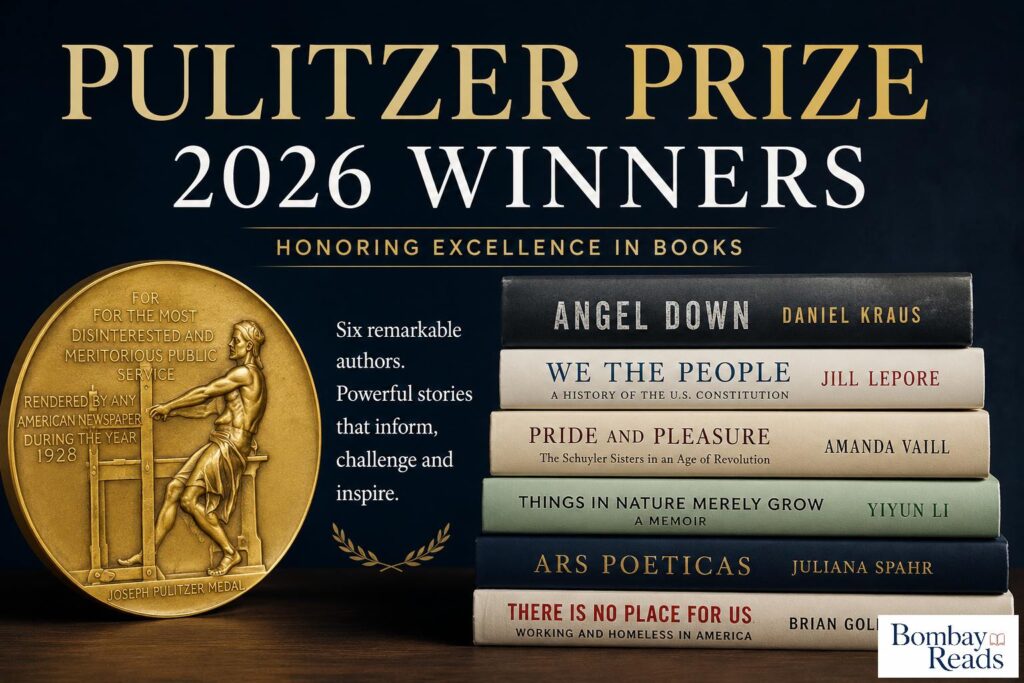
The 2026 Pulitzer Prize book winners have placed a striking mix of war fiction, constitutional history, revolutionary-era biography, personal grief, poetry and housing insecurity at the centre of America’s literary conversation.
In fiction, Daniel Kraus won for Angel Down, a World War I novel that the Pulitzer board described as a “stylistic tour-de-force” blending allegory, magical realism and science fiction into a single-sentence narrative. The book follows soldiers who encounter a fallen angel in No Man’s Land, turning the battlefield into a space of moral crisis as much as military horror. Kraus, long associated with horror, science fiction, graphic novels and young-adult writing, represents a less conventional Pulitzer fiction winner, which makes the award notable in itself.
The history prize went to Jill Lepore for We the People: A History of the U.S. Constitution. The Pulitzer citation praised the book as a lively account of why the Constitution has been so difficult to amend, particularly through the lens of proposed amendments linked to marginalised groups. Lepore, a Harvard professor and staff writer at The New Yorker, has long been regarded as one of America’s leading public historians, and this award further consolidates that reputation.
In biography, Amanda Vaill won for Pride and Pleasure: The Schuyler Sisters in an Age of Revolution, a work rooted in the lives of the Schuyler sisters during the American revolutionary period. Alongside Lepore’s constitutional history, Vaill’s book shows how this year’s Pulitzer book awards returned repeatedly to the country’s founding era, but through different literary and historical routes.
The memoir or autobiography prize went to Yiyun Li for Things in Nature Merely Grow, a deeply personal account shaped by the deaths of her two sons. The Associated Press described the work as Li’s blunt account of their suicides, placing it among the year’s most emotionally severe winners. In a field often associated with personal testimony, Li’s win highlights the Pulitzer’s willingness to recognise writing that is painful, restrained and unsentimental.
The poetry prize was awarded to Juliana Spahr for Ars Poeticas. AP described the collection as a statement on poetry’s vitality during dark times, while the Pulitzer list placed it alongside the year’s other major literary winners. The award gives renewed attention to a poet, critic and editor whose work often engages with politics, language and collective life.
In general nonfiction, Brian Goldstone won for There Is No Place for Us: Working and Homeless in America. The book examines homelessness among working people, bringing together labour, housing and economic insecurity in a subject that remains urgent across the United States. Goldstone’s background as a journalist is central to the book’s force, giving the category one of its most socially direct winners of the year.
About the Pulitzer Prize
The Pulitzer Prizes were established through the will of Joseph Pulitzer, the Hungarian-born newspaper publisher behind the New York World and St. Louis Post-Dispatch. Pulitzer’s 1904 will provided for awards in journalism, books and drama, education, and scholarships, with the first prizes awarded in 1917 under Columbia University’s supervision.
Over time, the prize system expanded to 23 awards, adding areas such as poetry, music, photography, memoir and audio journalism while retaining its original purpose: recognising work judged to serve excellence and public value. In literature, a Pulitzer does more than decorate a dust jacket. It can transform readership, cement reputation and push difficult books into the public square. For the 2026 winners, that means wider attention for books confronting war, democracy, grief, history, language and economic survival.

Books are the most personal source of entertainment, inspiration, and learning. Every person has a unique perspective, and Bombay reads is here to share its own! It doesn’t matter whether the book is breaking current charts or is an age-old classic, We like to read every story that we get our hands-on. More than reviews, Bombay reads write what it feels about the book, just like someone swimming in the river, not to win a competition, but to enjoy the pleasures of swimming. If you are a first-time self-published author, Bombay reads will read and review your book for free