
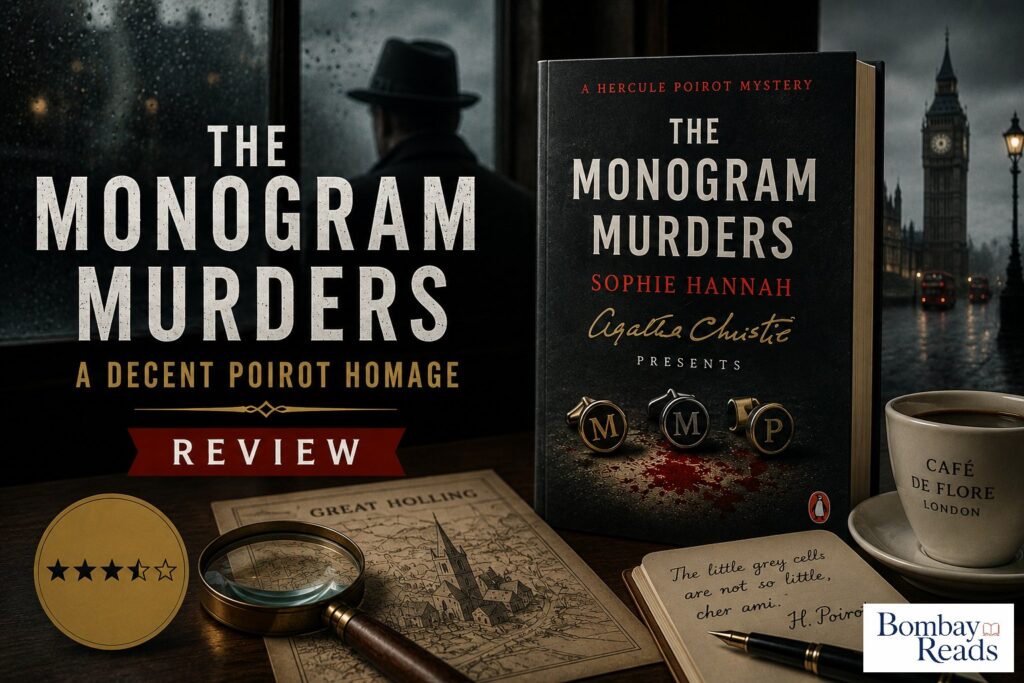
Rating: 3.5/5
The idea of reading another Hercule Poirot novel is exciting. No matter who writes it, the name Poirot carries a certain promise. You expect elegance, arrogance, impossible clues, polite conversations hiding ugly truths, and finally, that grand moment where the great detective explains everything while everyone else quietly accepts intellectual defeat.
That is the charm of Poirot. That is also the problem with The Monogram Murders.
Sophie Hannah’s novel gave me mixed feelings. I was happy to return to Poirot’s world. I liked the plot. The ending did surprise me. The mystery had enough strength to keep me going. Yet, when I finished the book, I was left with a strange dissatisfaction. It was decent, but it did not have the kind of brilliance that makes Christie’s original Poirot novels unforgettable.
It is a good homage. Respectful, readable, and engaging in parts. But it is also lackluster. The magic is there in glimpses, and then it disappears.
Brief Plot Summary
The novel begins in a London coffee house, where Hercule Poirot meets a frightened woman who seems convinced that she is about to be murdered. Soon after, three people are found dead in a hotel. Each victim has a monogrammed cufflink placed in the mouth.
That is a strong setup. Strange, theatrical, and very Poirot-like.
The investigation is followed largely through Edward Catchpool, a Scotland Yard detective who becomes Poirot’s companion in the case. From the hotel murders, the story slowly moves into deeper territory, especially when Catchpool reaches the village of Great Holling. There, the mystery widens. Old relationships, past tragedies, village memories, and hidden guilt begin to enter the picture.
The novel has enough plot to keep a mystery reader occupied. It has deaths, secrets, emotional histories, suspicious characters, and a final explanation that ties everything together. I will not reveal the solution here, because the book is still worth reading for the puzzle. But yes, the answer is complicated. At times, perhaps a little too complicated.
What Works
The best thing about The Monogram Murders (UK) is the mystery setup. A terrified woman in a café, three dead bodies in a hotel, and monogrammed cufflinks placed in their mouths — this is the kind of opening idea that immediately feels suited to a Poirot story.
The café scenes worked well for me. The atmosphere is quiet, but there is a sense that something is wrong. The waitress is also quite interesting, and her presence gives the early part of the novel some life. The café does what a good mystery setting should do: it makes you feel that ordinary people may be carrying extraordinary secrets.
But the novel truly improves when Catchpool goes to Great Holling. That was easily my favourite part. The village, the church, the characters, and the background story involving the toy car and the husband and wife gave the novel its strongest emotional and atmospheric moments.
The church setting was especially beautiful. There was something old, quiet, and sad about that part of the book. It felt like the kind of place where the past does not stay buried properly. Great Holling gave the novel weight. Before that, I was struggling. After that, I was interested.
I also liked Sophie Hannah’s writing style. It reminded me of Christie, but it had a modern flair of its own. The language was clean and readable. It did not feel heavy. Some parts were over-explained, but not to the point where the prose became irritating. For the most part, the writing carried the story well.
What Does Not Fully Work
The opening is the biggest weakness. It is slow. Too slow. In fact, the early part of the book was a real struggle for me. I had to push myself to continue reading.
That is dangerous for a mystery novel. A mystery does not need to begin with explosions or dead bodies on every page, but it must create hunger. It must make the reader want to know what happens next. The beginning of The Monogram Murders had a good premise, but the pace felt dull for too long.
The book improves later, especially with Great Holling, but the damage is done. A weaker reader may give up before reaching the better sections.
Then there is Poirot himself. Sophie Hannah’s Poirot is decent. He is recognisable. He has intelligence, confidence, drama, and that familiar belief in his own method. I enjoyed him in many places. But he lacks depth. At times, he becomes too melodramatic.
This does not ruin the book, but it does reduce the pleasure. Christie’s Poirot could be dramatic, even theatrical, but there was always control behind it. Hannah’s Poirot sometimes feels like someone performing Poirot. The performance is respectable, but the soul does not always come through.
Edward Catchpool is another mixed part of the novel. I found him interesting in certain ways. His hesitation, his lack of self-confidence, and his difficulty in speaking his mind made him feel real. He is not the kind of detective who walks into every room like he owns the world. That vulnerability was good.
But his fear connected to seeing a dead body felt over the top and unnecessary, especially for a policeman. I understand that detectives can have trauma, fear, weakness, and emotional baggage. Still, this particular detail did not fully convince me. Overall, Catchpool was more dull than interesting.
The emotional side of the book also felt weak. The mystery is engaging, but I could not really empathise with Jenny or Nancy. Their stories matter to the plot, but they did not stay with me. I understood their importance. I did not feel much for them.
Christie and the Poirot Problem
I did not want to read The Monogram Murders only as a comparison with Agatha Christie. That would be unfair to Sophie Hannah. But after reading Christie’s original Poirot novels, comparison becomes almost impossible to avoid.
Poirot belongs to Christie in a very deep way. He is not merely a clever detective with a moustache. He is a complete fictional presence. His speech, vanity, morality, intelligence, irritation, and humour all work together. Christie made him feel alive without overloading the page.
Hannah gives us glimpses of that Poirot. There are moments where the book feels close to the original world. But those moments are too few. The novel cannot be placed in the same bracket as Christie’s Poirot stories.
The final solution is reasonably satisfying. It is clever, and I did enjoy the surprise. But it is also a bit too entangled. Christie had the rare gift of making complex mysteries feel sharp and inevitable. Hannah’s solution works, but it feels more laboured.
That is the difference. Christie could make shock feel effortless. Here, the surprise arrives, but without the same force.
Final Verdict
The Monogram Murders is a decent homage to Hercule Poirot. It has a strong mystery idea, a readable style, and some genuinely good sections. The café scenes are effective, and Great Holling gives the novel its best atmosphere. Once the story reaches that village, the book becomes far more engaging.
But the slow opening tested my patience. Poirot, while enjoyable, sometimes felt too dramatic. Catchpool had some realistic qualities, but he remained dull overall. The emotional core of the novel did not fully work for me.
I would recommend this book more to readers who are new to mystery fiction. If someone has not read much Christie, they may enjoy the plot without constantly measuring it against the original Poirot novels. Long-time Poirot readers can read it too, but they should keep their expectations controlled.
As for me, I would read more of Sophie Hannah’s Poirot novels, but not immediately. I would first complete Christie’s works and explore more classic mystery fiction. After that, I may return to Hannah’s Poirot.
For now, The Monogram Murders (India) remains a decent, respectful, and somewhat enjoyable mystery. It gives you another meeting with Poirot, and that itself has some charm. But it also reminds you why Agatha Christie is so difficult to follow.

Editor – Bombay Reads
Noman Shaikh holds an MA in English Literature (University of Mumbai) and an MSc in Accounting and Finance (University of Portsmouth). His reviews at Bombay Reads combine literary interest with a practical reader’s perspective, focusing on storytelling, themes, style, and the overall reading experience.